How to route inbound calls to the right buyer
Inbound call routing is the set of rules that decides where an incoming call goes. In pay-per-call, it sends each call to a buyer who wants that call, can take it right now, and ranks first.
It does two jobs. Filters decide whether a buyer is eligible for the call. The routing method decides which eligible buyer gets it.
Why routing rules exist
A buyer, the business that receives and pays for calls, rarely wants every call. It buys certain states, certain hours, and a set number of calls a day.
Without rules, a call reaches a buyer who is closed, full, or doesn't want that caller. Routing rules send each call only where it fits, and move on when the first choice can't answer.
How an inbound call is routed, step by step
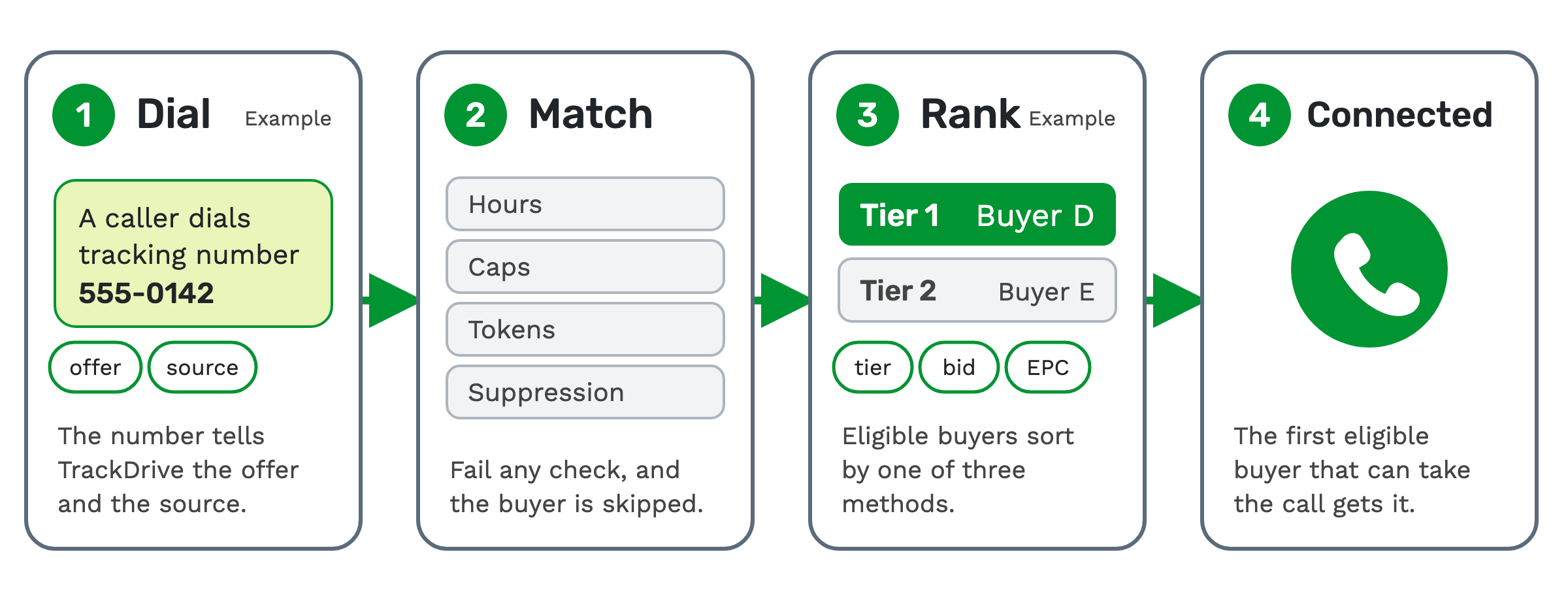
1. The caller dials. The tracking number resolves the offer and the traffic source. A tracking number is a phone number tied to one source, so every call is credited to where it came from. An offer is the campaign the call belongs to: its numbers, its buyers and its payouts. (What is inbound call tracking?)
Next come the greeting and IVR. An IVR, or interactive voice response, is a recorded menu the caller answers with key presses. It can collect key presses and token data. A token is one named piece of call data, such as the caller's state.
2. Buyer matching. TrackDrive checks every buyer on the offer against its hours, caps, tokens and suppression list.
3. Ranking. Eligible buyers are sorted by the routing method. TrackDrive returns the first one that can take the call.
4. Connected. The caller is bridged to that buyer, and the call carries its offer, buyer and revenue into reporting.
What gets checked before a buyer can take a call
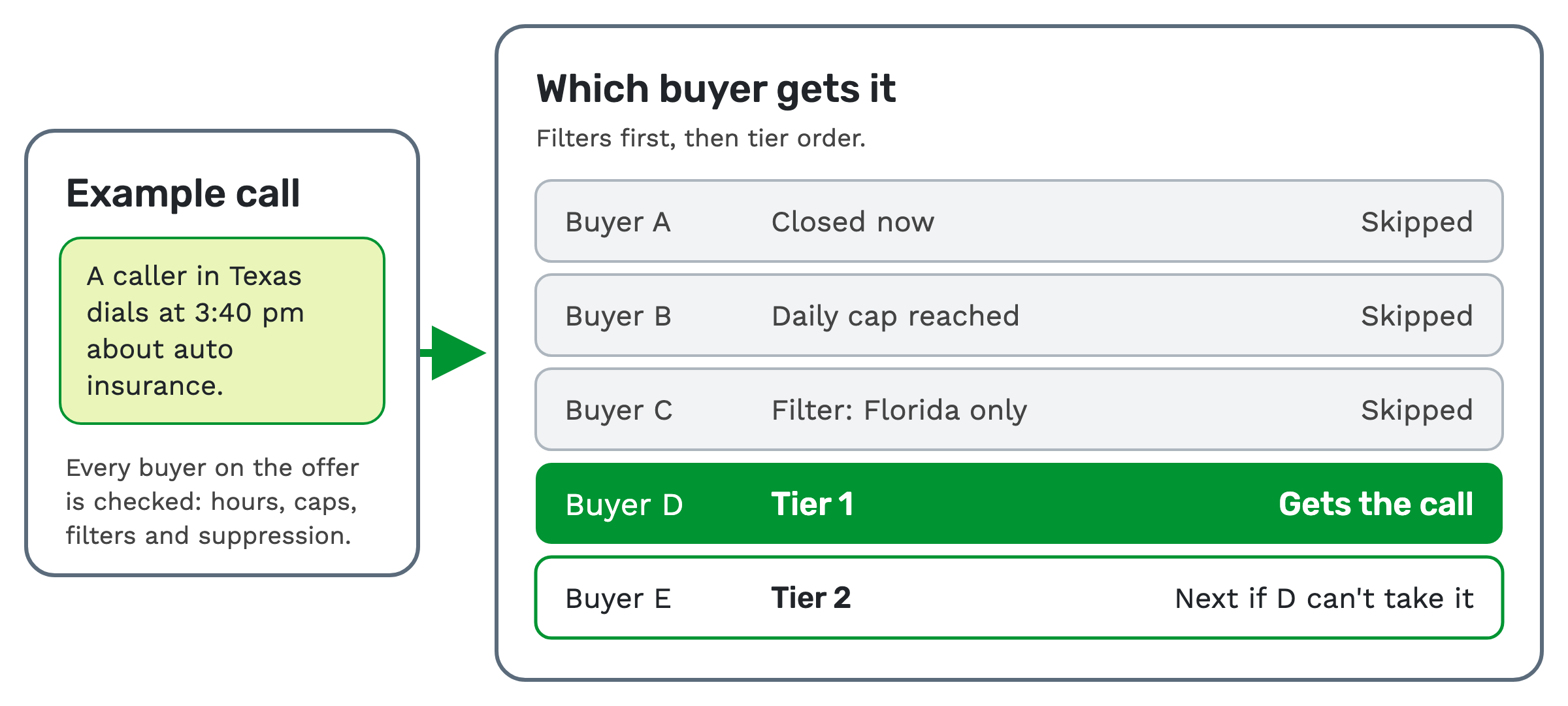
A buyer must pass every check below, or it's skipped for this call.
- Filters. Token-based filters match call data with operators such as equals, not-equals, regex, numeric comparisons and in or not-in. You can target by geography, vertical, lead quality or any custom token. A call reaches a buyer only if it meets all of that buyer's filters.
- Hours. A 7-day by 24-hour grid sets when each buyer is eligible. Outside those hours, the call falls through to the next buyer.
- Caps. A cap is a limit on how much a buyer takes. You can cap attempts, connections, conversions or revenue, daily, monthly or in total, plus hourly caps.
- Concurrency. A concurrency cap is the most live calls a buyer can hold at once. At that limit, the call skips to the next buyer.
- Suppression. Each buyer's suppression list is checked before the call is forwarded. On offers with blacklist rejection turned on, a company-wide blacklist blocks the caller entirely.
 A capped buyer isn't paused. It's marked as maxed out and comes back on its own when an hourly, daily or monthly cap
resets. A total cap never resets on its own: raise its limit by hand to reopen the buyer. The
buyer caps guide covers each cap type.
How the buyer is picked
Once the ineligible buyers are out, the routing method ranks the rest. TrackDrive offers three routing methods.
- Tier and weight. Lower tiers get calls first: tier 1 before tier 2. Within a tier, weight shares the calls. A weight-3 buyer gets roughly three calls for every one a weight-1 buyer gets.
- Bid price. The highest bid wins: buyers offering the most revenue per call are ranked first.
- EPC. EPC, or earnings per call, ranks buyers by what calls have historically earned with them.
The method is set per buyer, so buyers on the same offer can each sort a different way. The buyer selection guide has the details.
Ping-post is another way to pick the buyer: buyers bid live before the call connects. See what is ping-post.
Ring one buyer, or several at once
A buyer group puts several buyers under one set of rules. It can ring every buyer at once, and the first to answer gets the call, or the first to press 1 if Press 1 to Accept is on. It can also dial them one by one.
A group shares its caps across its buyers, and its tier and weight override each buyer's own.
What happens when no buyer can take the call
Sometimes every buyer is closed, full or filtered out, and TrackDrive fires an exception call flow for that case. A call flow is a rule that decides what happens next in a call.
There are exception flows for four cases: no buyers have open concurrency, all buyers are closed, no buyer answered, and no buyers match. You choose the action for each.
When every buyer is busy, a hold queue keeps callers waiting with music. They connect when a buyer opens up. If the queue is full, you can schedule a callback.
Buyers, agents or AI voice agents
The same routing sends calls to buyers, to your own agents, or to AI voice agents. A call can also switch destinations mid-call when intent or filters change.
Seeing why a call went where it did
The call router records every buyer it tried, the dial result, and why any buyer was skipped. Typical reasons are caps reached, a schedule mismatch or a hold queue timeout.
TrackDrive also measures audio quality on every leg it routes. It flags dead air and one-way audio.
When simple routing is enough
If you sell to one buyer, one tier with business hours is all you need. Add filters and caps when buyers set terms on what they'll take.
Add more tiers or EPC ranking when several buyers want the same calls. Use ping-post when they want to bid on each one.
What it costs on TrackDrive
Inbound calls are billed per minute, rounded up to the full minute. The rate includes forwarding the call to your buyer over toll-free or SIP; international and premium rate centers can add cost. Local and toll-free calls each have their own rate, and forwarding to a buyer's local number costs more. Each tracking number has a monthly rate.
There's no onboarding fee. See TrackDrive pricing for commit plans.
Questions people ask
How do I route inbound calls to the right lead buyer automatically? Give each buyer its filters, hours and caps, then pick a routing method. On every call, TrackDrive checks each buyer and connects the first eligible one in ranked order.
What's the difference between a filter and a routing method? A filter says yes or no for one buyer. The routing method puts the buyers that said yes in order.
Does a buyer at its cap need to be switched back on? Not for hourly, daily or monthly caps; they reset on their own. Daily caps reset at midnight in the buyer's time zone, and monthly caps on the first of the month. A total cap never resets on its own: raise its limit by hand.
Can one offer use more than one routing method? Yes. The method is set per buyer, so tier, bid price and EPC buyers can sit on the same offer.
See it in action
Request a demo for a live walkthrough tailored to your use case, or start free, with no credit card and no onboarding fee.